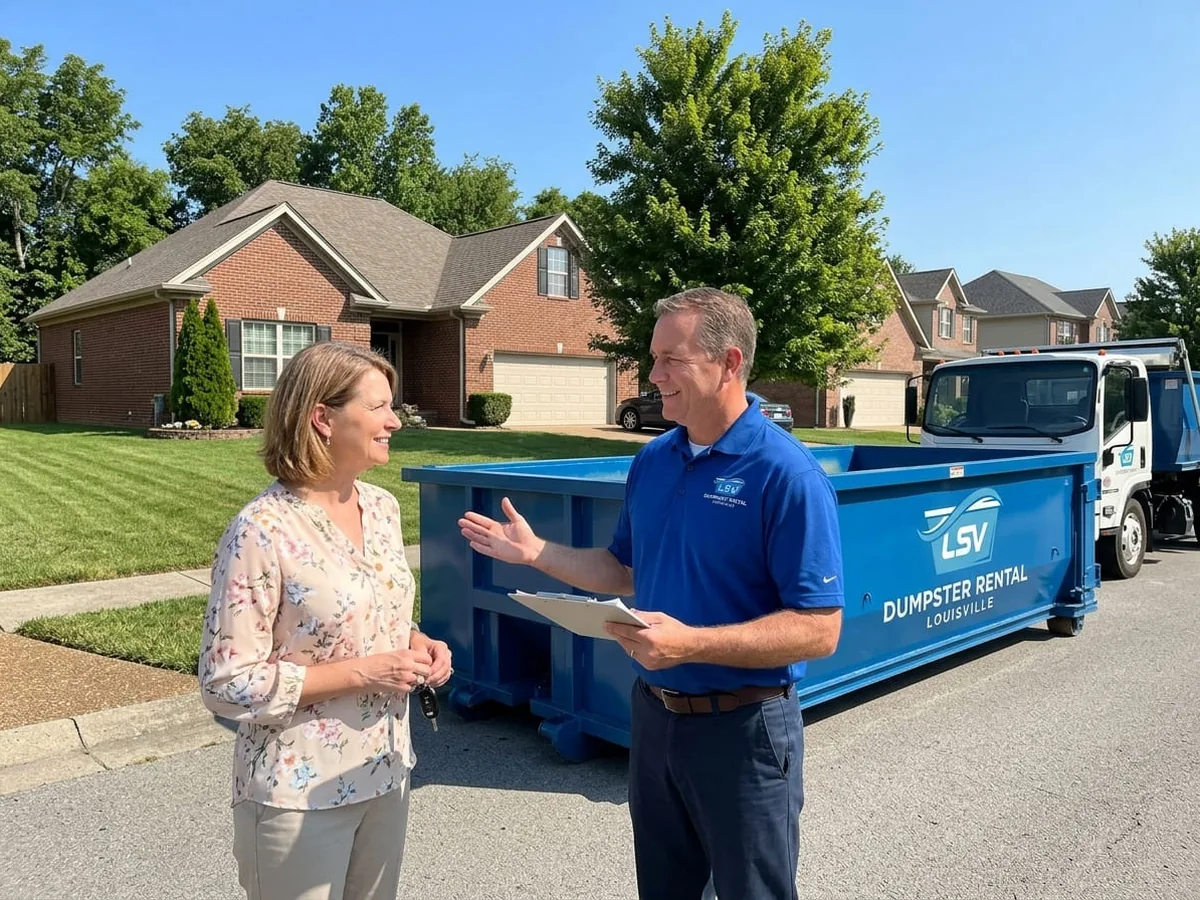
Picking a dumpster size is less about guessing and more about matching a container to two things: how much material you're actually clearing, and how much room you have to put it. We deliver all five standard roll-off sizes across Louisville Metro, from tight lots in older neighborhoods to wide driveways out in the eastern subdivisions near our Aiken Rd yard, and the right call usually comes down to project type, weight of the debris, and where the container has to sit once it lands.
Here's a side-by-side look at all five sizes, followed by more detail on when each one makes sense.
10 Yard: The Small-Job Workhorse
The 10-yard container is the one we deliver most often for single-room cleanouts, a small bathroom tear-out, or a driveway full of shingles after a roof tune-up. At 14 feet long and only 3.5 feet high, it fits into tight side yards and shorter driveways that you'll find on the smaller lots around Shively, Okolona, and parts of Jeffersontown. Because it's rated for 1-2 tons, it also works well for dense, heavy loads like concrete or dirt where volume isn't the limiting factor, weight is.
15 Yard: The Middle Ground
The 15-yard steps up in length and height without needing much more footprint than the 10-yard. It's a common choice for garage cleanouts, old carpet and subfloor removal, and yard waste jobs, especially after a spring storm knocks down limbs across Fern Creek or Highview. If a 10-yard feels like it might run short but a 20-yard feels like overkill, this is usually the right landing spot.
20 Yard: The Renovation Standard
Most kitchen remodels, mid-size bathroom renovations, and roofing jobs on larger homes land in the 20-yard range. At 22 feet long, it needs a bit more clear driveway or street space, which is easy to find in the newer subdivisions around Middletown and Lyndon but can be tighter on some of the older, narrower streets closer to the urban core. It's also a popular size for large whole-house cleanouts where volume, not just weight, is the driving factor.
30 Yard: Multi-Room and Estate Projects
Once a project spans several rooms, or you're clearing out a full house for an estate cleanout, the 30-yard gives you the extra height to stack bulkier items, furniture, cabinetry, and construction debris, without needing a longer footprint than the 20-yard. This size is common on larger properties in eastern Jefferson County where there's room to set it off to the side of a wide driveway or on a section of yard.
40 Yard: Commercial and Major Demolition
The 40-yard is our largest container and the one we route to commercial sites and major demolition or new-construction jobs. Because it's 8 feet tall, it needs a location with real overhead clearance, away from low tree limbs or power lines, and a delivery approach a roll-off truck can back into comfortably. This size is less common on residential streets simply because most homes don't generate 5-6 tons of debris, but for a full teardown or a commercial buildout it's the right tool.
Matching Size to Property, Not Just Project
Two houses doing the identical renovation can need different sizes once you factor in where the container actually sits. A newer home in Anchorage or out toward Middletown, closer to our yard off the Snyder Freeway, often has a wide concrete driveway with plenty of clearance, so sizing up isn't a placement problem. On older, narrower lots closer to town, or in neighborhoods where street parking is tight, the limiting factor is frequently space rather than debris volume, and that can push the right choice down a size even if the project itself would technically fill a bigger box.
Weight matters just as much as volume. A 20-yard container full of drywall and old furniture behaves very differently than a 10-yard full of concrete, brick, or roofing shingles. Dense material hits its tonnage limit long before it fills the box visually, which is why our size recommendations always ask about material type, not just square footage of the project.
Placement on Private Property vs. the Street
Most residential deliveries across Jefferson County sit entirely on private property, a driveway, a side yard, or a cleared section of lawn, where no permit is typically required. If your property doesn't have room and the container needs to sit on a public street or sidewalk instead, a temporary permit from Louisville Metro Public Works' Right of Way Permits and Licenses division is usually the path, and that's worth sorting out before delivery day rather than after the truck shows up.
Still Not Sure Which Size Fits?
If you're between two sizes, it's almost always safer to size up slightly than to run short and need a second haul mid-project. When you call to book, tell us what you're clearing out and where the container will sit, driveway, street, side yard, and we'll walk through which of the five sizes actually fits both your project and your property.