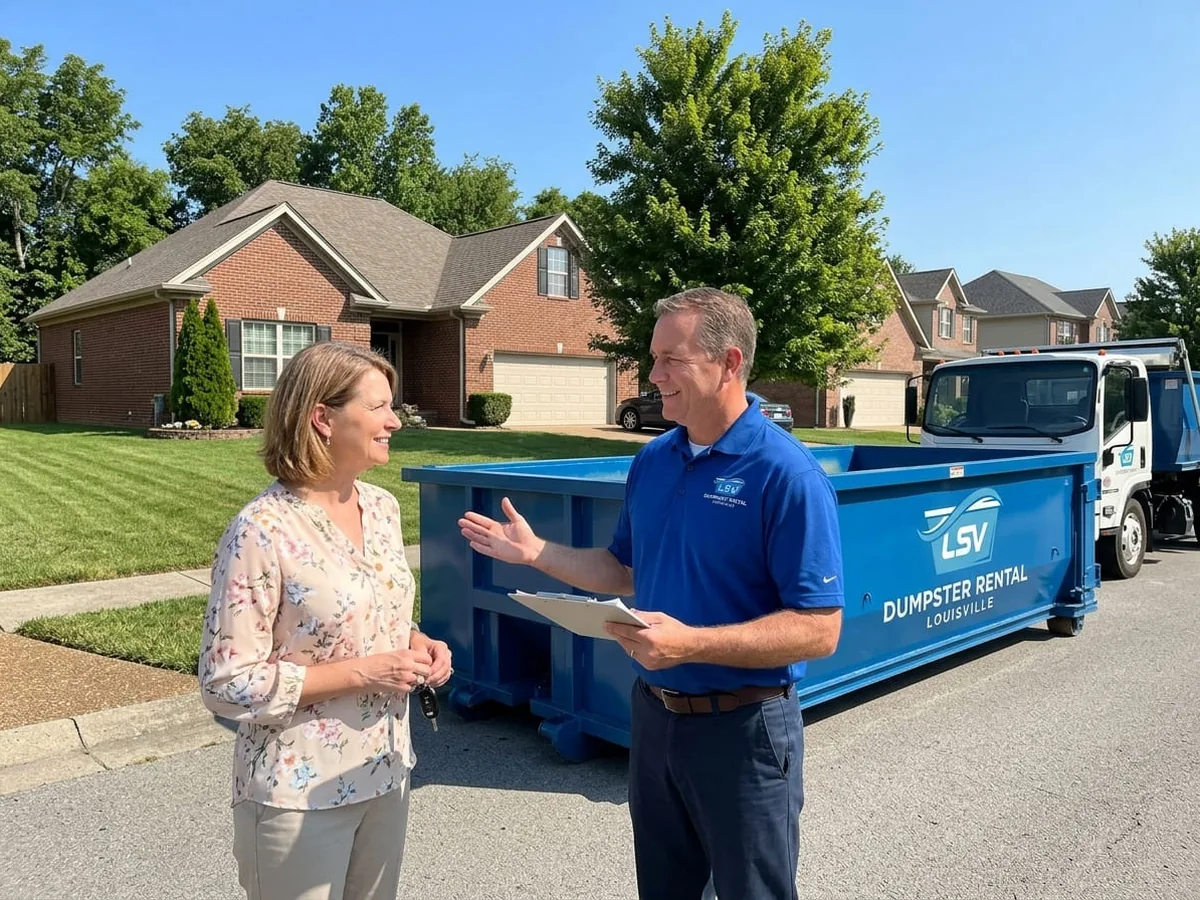
Where a dumpster actually sits, not just what size you order, is what determines whether delivery day goes smoothly or turns into a headache. Across Jefferson County we deliver to everything from wide concrete driveways in newer eastern subdivisions to gravel lanes in unincorporated communities like Fern Creek and Highview, and each of those surfaces and layouts calls for a slightly different approach to placement and protection.
Private Property First, Street as the Backup
The simplest and most common placement is entirely on private property, a driveway, a side yard, or a cleared area of the lot. Placed this way, a dumpster typically doesn't require a permit. If your property genuinely doesn't have room, a wooded lot with no clear pad, a townhome with no driveway, or a job site still under construction with no usable surface, the container can go on a public street or sidewalk instead, but that generally requires a temporary permit through Louisville Metro Public Works' Right of Way Permits and Licenses division. It's worth confirming which category your job falls into before delivery day, since street placement also means coordinating around parking, mail delivery, and trash pickup schedules for the block.
Protecting a Driveway
A fully loaded roll-off container is heavy, and the weight is concentrated on a relatively small set of contact points where the rails meet the ground. On asphalt, especially during a hot Louisville summer when the surface softens, that concentrated weight can leave indentations if nothing is underneath it. On concrete, the risk is usually less about denting and more about existing hairline cracks spreading under sustained load. The fix in both cases is the same: a barrier between the container and the surface. Plywood sheets, purpose-made protective boards, or even 2x material laid under the rail contact points spreads the load out and meaningfully lowers the risk of marks or cracking. If you're particular about a newer driveway, mention it when you book and we'll make sure protection is part of the delivery.
Protecting Grass and Landscaping
When a driveway isn't an option and the container needs to sit on the lawn, plan for some impact to the grass underneath, especially if it sits for more than a few days. Boards or plywood help here too, and choosing a spot that drains well rather than a low, soggy corner of the yard reduces rutting from the delivery truck as it maneuvers into place. If you've got landscaping near the likely drop zone, flag it before delivery so the driver can plan the approach angle around it rather than through it.
Clearance the Truck Actually Needs
Delivering and picking up a roll-off container isn't like parking a car. The truck needs a relatively straight, level approach to slide the container off the back, along with overhead clearance for the truck itself as it backs in. Low tree limbs are a common issue on older, tree-lined streets throughout Louisville, and they matter twice over here: not just for the delivery truck, but because those same limbs are exactly what comes down during spring straight-line wind events and winter ice storms, which is often why people are renting a dumpster in the first place. If a low branch or power line sits near your planned placement spot, mention it when scheduling so we can plan the approach or discuss an alternate location.
Placement Differences Across Jefferson County
The right placement approach genuinely varies by where in the county you're located. Newer subdivisions around Middletown, Anchorage, and Lyndon typically have wide, straight concrete driveways with generous turning room, which makes placement straightforward and gives more flexibility on container size. Older neighborhoods closer to the urban core, along with some streets in Jeffersontown and St. Matthews, tend to have narrower driveways and less street parking buffer, which sometimes pushes the decision toward the street with a permit, or toward a smaller container that fits the available pad. In unincorporated communities like Fern Creek, Highview, Okolona, and Pleasure Ridge Park, lot sizes and surface types vary widely, gravel drives, dirt lanes, and larger unpaved yards are all common, so protection boards matter as much for keeping the truck from rutting a soft surface as for protecting the dumpster's landing spot itself.
HOA and Neighborhood Considerations
Some of the newer eastern subdivisions have homeowners' association guidelines around how long a dumpster can sit in a driveway or whether it needs to be positioned a certain way relative to the street. Those rules aren't something we can look up on your behalf, so if you know your neighborhood has an HOA, it's worth a quick check before the container is scheduled to sit for an extended rental period.
Seasonal Placement Notes
Ground conditions shift with the seasons here. After heavy spring rain, lawns and unpaved surfaces can turn soft enough that a loaded container settles unevenly or the delivery truck struggles for traction, so a driveway or gravel pad is the safer bet during wet stretches. In the depth of winter, frozen or icy ground changes the calculation in the other direction, a hard, uneven surface can make protective boards even more important under the rail contact points. If you're scheduling around a known ice storm or a stretch of spring storms, mention it when you call so we can plan delivery timing around the weather rather than into it.
Getting Placement Right the First Time
The fastest way to avoid a placement problem is to describe your property when you book: surface type, available width and length, overhead clearance, and whether the spot is on private property or would require the street. That lets us confirm the size fits, bring the right protective materials, and plan the truck's approach before it ever leaves the yard on Aiken Rd.